
Most residential pickleball courts in the Kansas City area need resurfacing every 4 to 8 years, but the real trigger is condition, not the calendar. Knowing when to resurface a pickleball court comes down to watching for hairline cracks spreading, faded lines, slick spots where the texture has worn smooth, or standing water that lingers after a storm. Waiting past those signs usually turns a straightforward job into a far more expensive structural repair, which is exactly what drives up the pickleball court resurfacing cost.
Key takeaways
- Typical cycle: plan to resurface a pickleball court in Kansas City every 4 to 8 years, sooner for courts in full sun or poor drainage.
- Watch for: cracking, surface wear and loss of grip, fading color, birdbaths (ponding water), and peeling or bubbling acrylic.
- Best window: late spring through early fall, when daytime temperatures hold above roughly 50°F and overnight lows stay mild enough for acrylic coatings to cure.
- Budget range: a resurface costs a fraction of a full rebuild, so acting on early signs keeps the pickleball court resurfacing cost low and protects the asphalt or concrete base underneath.
- Not a DIY job: coating adhesion, slope, and crack prep all affect how long the work lasts, so get a professional assessment.
Why Kansas City weather shortens the clock
Kansas City sits in a punishing freeze-thaw zone. Our winters swing above and below freezing repeatedly, and that daily cycle is the single biggest enemy of an outdoor court surface. Water seeps into a hairline crack, freezes overnight, expands, and pries the crack wider. By spring, what was a cosmetic line has become a tripping hazard. According to the National Weather Service, the metro experiences repeated freeze-thaw transitions in a typical cold season, which is why courts here age faster than those in milder climates.
Summer is just as hard on the top coat. UV exposure during long, hot Missouri summers breaks down the pigments and binders in acrylic color coats, so a court in an open backyard in Lee’s Summit or Blue Springs will fade and chalk faster than a shaded one. Add the clay-heavy soils common across Jackson and Clay counties, which hold moisture and shift with the seasons, and you have a recipe for base movement that telegraphs cracks up through the surface.
The signs your court is ready
Do a slow walk of your court in good daylight after it has dried out. Here is what a seasoned installer looks for before deciding it is time to resurface a pickleball court in Kansas City.
Cracking
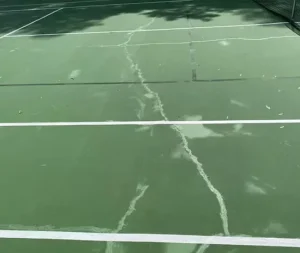
Thin, isolated cracks can often be filled and coated over. A spiderweb pattern, cracks wider than a credit card, or cracks that have started to lift at the edges point to base movement, which needs repair before any new coating goes down. Our crack repair process addresses these before they spread.
Loss of texture and grip
Pickleball generates a lot of quick lateral movement. The sand-filled acrylic texture that gives you traction wears down in the high-traffic zones first, usually around the non-volley line and baselines. If those areas feel noticeably slicker than the corners, the court has lost the grit that keeps play safe.
Fading and color loss
Beyond looks, faded color often means the protective coat is thinning. Once the color coat is compromised, UV and moisture reach the base layers faster.
Ponding water
After a rain, mark any spots where water sits for more than an hour. These birdbaths signal that the surface, or the slope beneath it, has settled. Persistent ponding may call for drainage work rather than a surface-only fix.
Pickleball court resurfacing timeline: what to expect
A straightforward residential job typically runs several days from start to playable, weather permitting. The pickleball court resurfacing timeline usually looks like this:
- Clean and prep: pressure wash, kill any vegetation at the edges, and let the surface dry fully.
- Repair: fill cracks, patch low spots, and address ponding areas so the finished court drains.
- Resurface coats: apply an acrylic resurfacer, then two or more color coats, each needing time to cure between applications.
- Line striping: mask and paint regulation pickleball lines last.
Curing is the part homeowners underestimate, and it is the biggest variable in the pickleball court resurfacing timeline. Each acrylic coat needs dry conditions and warmth to set properly, so a humid stretch or a surprise summer thunderstorm can push the schedule. This is why the late-spring-through-early-fall window matters so much in our climate. For a deeper look at scheduling, see our guide on how often courts should be resurfaced in Kansas City.
What the pickleball court resurfacing cost depends on
The pickleball court resurfacing cost depends on court size, how much crack and base repair is needed, the number of color coats, and whether drainage correction is involved. A court that gets resurfaced on schedule, before cracks reach the base, sits at the low end. A court that was left until water had already undermined the asphalt can cost several times more because it crosses from a resurface into a reconstruction. For the full picture of repair versus full replacement, our page on court repair and resurfacing breaks down the options.
The practical takeaway for Kansas City homeowners: a modest, on-time resurface protects the far larger investment in your base. The USTA notes in its facility guidance that acrylic surfaces should be recoated on a regular maintenance cycle to protect the underlying pavement. You can review general court care standards from the USTA.
How to extend the time between resurfaces
Good habits add years. Sweep off leaves and tree debris before they stain, keep standing water from sitting, rinse the surface a few times a season, and have hairline cracks filled early instead of waiting for a full project. Keeping up with routine court maintenance is the cheapest insurance against needing to resurface a pickleball court in Kansas City ahead of schedule. If your court is already showing several of the signs above, the smart move is an assessment now, before Kansas City’s next freeze-thaw season widens what is there.
Not sure where your court stands? Reach out to our Kansas City team for an honest evaluation of whether a resurface or a repair is the right call.