
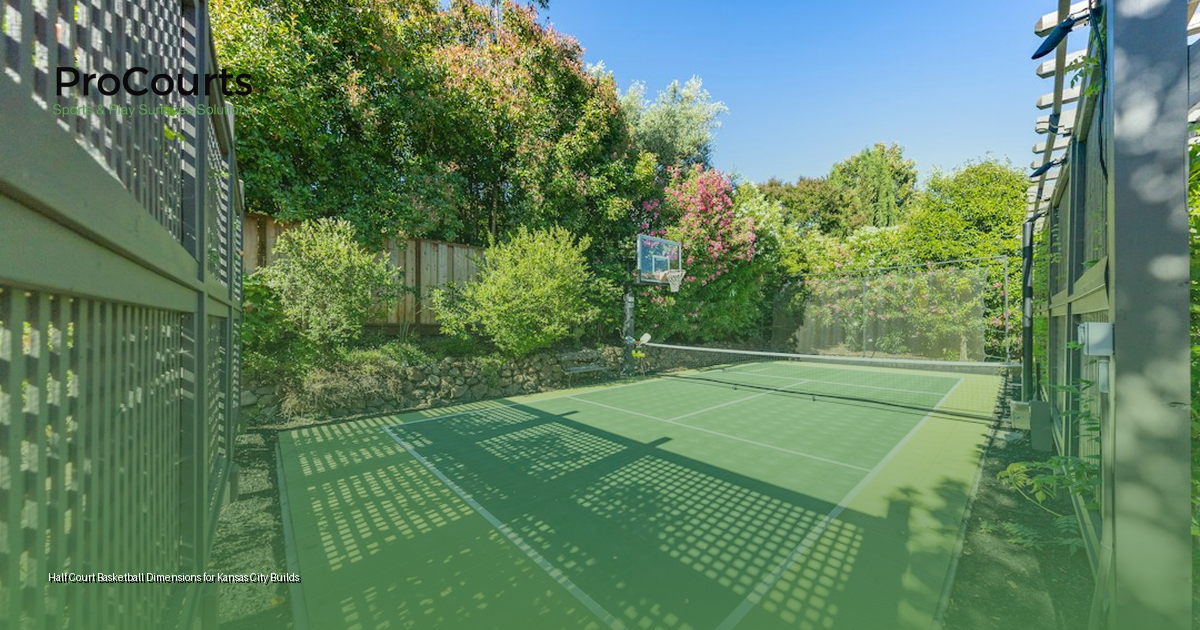
A regulation half court is 47 feet long by 50 feet wide, which mirrors exactly half of a 94-by-50-foot NBA full court. For a backyard build in Kansas City, most homeowners scale those half court basketball dimensions down to a 30-by-50 or 40-by-50 playing surface and then add roughly 3 to 5 feet of safety margin around the perimeter. The full regulation footprint is rare on a residential lot, so the real question is how much of it you keep.
Key takeaways
- Official half court: 47 ft deep x 50 ft wide, with a 15-foot free-throw line and a 16-foot-wide lane at the NBA level.
- Popular backyard scales: 30×50 (half court feel), 40×50 (near-regulation), and compact 20×25 single-hoop pads.
- Add 3 to 5 ft of run-off on all sides, plus clearance behind the hoop for rebounds.
- In Kansas City, check your plat for easements and side-yard setbacks before you commit to a size; these vary by lot and district.
- KC’s expansive clay soil and freeze-thaw swings make the base, not the paint lines, the part that decides how long your dimensions stay true.
Below we go past the number everyone quotes and into the geometry inside the court, the run-off nobody plans for, and the Kansas City site realities that quietly dictate what you can actually pour.
The official measurements, line by line
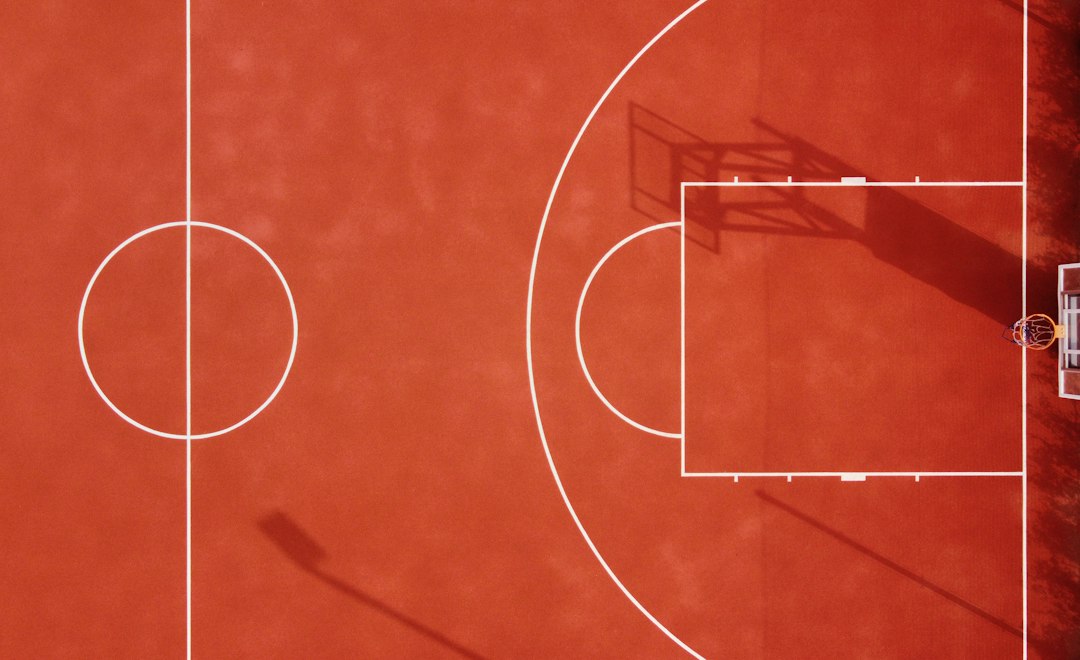
When people ask for official half court basketball dimensions, they usually mean the full set of markings inside that 47-by-50 rectangle, not just the outer edge. Here is what lives inside it:
- Overall half court: 47 ft (baseline to half-court line) by 50 ft wide for NBA; high school and NCAA courts share the 50-ft width but run 42 ft deep on an 84-ft full court.
- Free-throw line: 15 ft from the backboard face.
- The lane (key): 16 ft wide at NBA level, 12 ft wide for high school.
- Three-point arc: 23 ft 9 in at the top for the NBA, 22 ft in the corners; high school uses a simpler 19 ft 9 in arc.
- Center circle: 12 ft diameter, of which you keep the bottom half on a half court.
Governing-body specs are published by the sport’s national organization, and the National Federation of State High School Associations is the standard most residential installs borrow from, since few backyards need NBA-depth three-point arcs. For a deeper breakdown of the full-court figures, our guide to basketball court measurements in Kansas City lays out the rest of the markings.
Which scaled layout actually fits a Kansas City backyard
Very few lots in neighborhoods like Brookside, Waldo, or the newer builds out in Lee’s Summit and Liberty have a clean 50-by-56 patch of flat, unencumbered ground. So most KC backyard courts are scaled. Here is how the common sizes play:
- 20×25 (single hoop): Fits a narrow Midtown or Hyde Park lot. Good for shooting, one-on-one, and younger kids. No three-point line.
- 30×50 (half court): The sweet spot for most suburban KC yards. Room for a key, a free-throw line, and a shortened arc. Comfortable three-on-three.
- 40×50 (near-regulation): For larger lots in Parkville or on acreage toward the eastern edge of the metro. Full key, real arc, proper run-off.
Whatever outer dimension you pick, do not paint lines to the slab edge. Budget 3 to 5 feet of run-off on every side and extra clearance behind the backboard so a layup does not end at a fence. When homeowners compare backyard basketball court sizes, this run-off is the number most often left off the sketch, which is why a court that looked big enough on paper feels cramped once the lines go down. If you are weighing the whole project, our breakdown of backyard basketball court sizes in Kansas City compares footprints side by side so you can match a scale to your lot.
Setbacks, easements, and the KC-specific site check
Dimensions on paper mean nothing if the slab crosses a utility easement or a side-yard setback. In Kansas City, MO, setback and easement rules vary by zoning district and by the recorded plat of your specific lot, and a court pad plus fencing or lighting can trigger review. We always recommend pulling your plat and confirming requirements with Kansas City’s development services before you stake out corners, and consulting a licensed contractor or your local jurisdiction rather than assuming a neighbor’s court sets the precedent for yours.
Practical field notes we see across the metro:
- Older plats in neighborhoods like Waldo and Brookside often carry rear-yard utility easements that quietly shrink usable width.
- HOA-governed subdivisions in Johnson County and the Northland may restrict pole-mounted lights and backboard height.
- Drainage matters as much as dimensions. A flat court needs a planned slope to shed Kansas City’s heavy spring rain. See our overview of court drainage for how we route water off the surface.
Why the base matters more than the paint in Kansas City
Here is the part a tape measure will not tell you: in the Kansas City area, the thing that keeps your dimensions accurate over time is what is under the surface, not the lines on top. The region sits on expansive clay soils that swell when wet and shrink in drought, and the metro swings through sharp freeze-thaw cycles every winter. The humid-continental climate here, with hot humid summers and cold winters, drives those cycles hard.
That movement is what cracks a court and pushes lines out of true. A properly engineered base, correct slab thickness, and reinforcement are what hold a 30-by-50 rectangle square for a decade instead of two seasons. For the structural side of that decision, see our guide on whether you need a concrete base for a basketball court. The National Weather Service’s Kansas City / Pleasant Hill forecast office is a useful reference for the seasonal rainfall and freeze patterns that should shape your pour schedule.
Spring and early fall tend to be the most forgiving windows to pour and cure around here, avoiding both the wettest stretches and hard freezes.
Turning dimensions into a finished court
Once the size, setbacks, and base plan are settled, the surface and markings are the straightforward part. Color coating, a scaled key, a shortened arc, and a proper post anchor turn a slab into a court. If you want to see layout and color options before committing, start with our court color designer or reach out through our contact page to walk a specific KC lot. The right dimensions are the ones that fit your yard, respect your plat, and sit on a base built for Kansas City ground.