
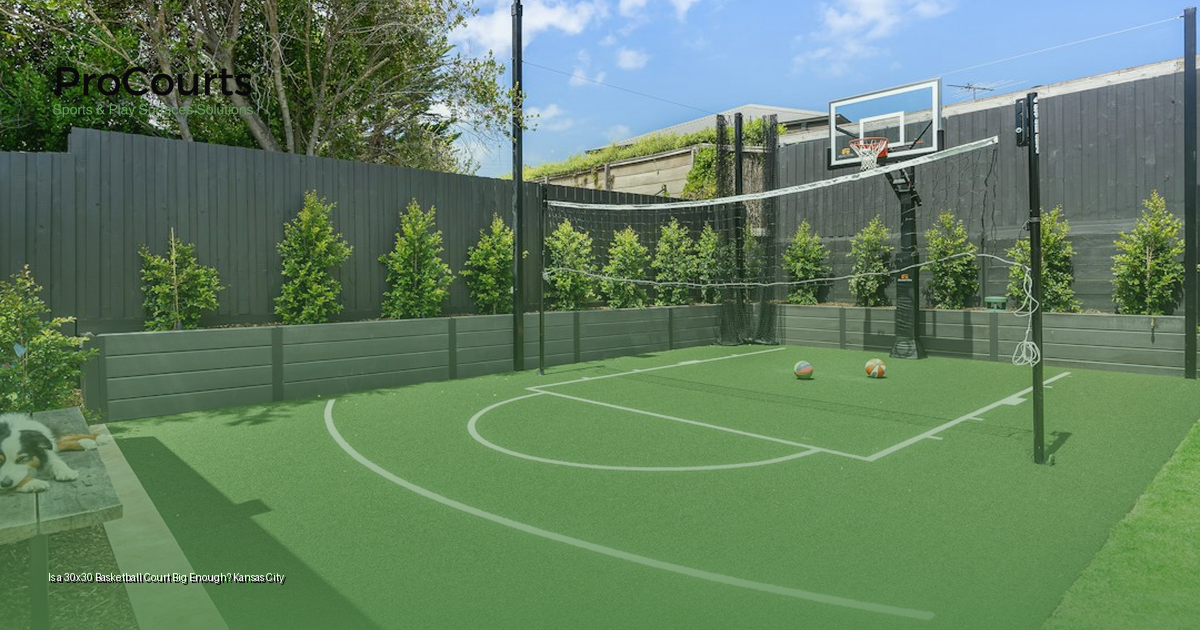
A 30×30 basketball court is big enough for a comfortable half-court setup in most Kansas City backyards. It gives you room for a single hoop, a three-point arc scaled to your needs, and enough run-off space for layups and shooting around without crowding a fence or garden bed. It is not large enough for a regulation full court, but for driveway-style games, skill work, and family play in neighborhoods from Brookside to Lee’s Summit, it hits the sweet spot between usable space and realistic yard footprint.
Key takeaways
- A 30×30 pad suits half-court play, shooting drills, and casual games for two to six players.
- A regulation high school half court is 42 feet by 50 feet, so 30×30 is a scaled-down recreational version.
- Kansas City’s freeze-thaw winters make the concrete base and drainage as important as the surface size.
- You can fit a 30×30 court on many standard KC lots, but check setbacks and slope before you commit.
- If you have room, stretching to 30×40 or wider adds meaningful playing value without doubling cost.
What You Can Actually Do on a 30×30 Court
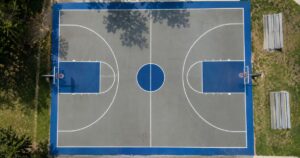
So, is a 30×30 basketball court big enough for the way your family actually plays? For most households, yes. Thirty feet by thirty feet is 900 square feet of playing surface. That is enough for one regulation hoop, a key, and a usable three-point line on a half-court layout. Most families use this size for one-on-one and two-on-two games, free-throw and jump-shot practice, and pickup sessions with the kids. The width gives shooters room to move along the baseline and wing without stepping off the pad.
What you give up at 30×30 is the deep space behind the arc and the generous side room you would find on a competition court. A regulation NBA three-point line sits 23 feet 9 inches from the rim at the top, which already eats most of a 30-foot depth before you add run-off. For backyard play that trade-off is usually fine. You are building a place to shoot, compete, and move, not to host a sanctioned tournament.
How 30×30 Compares to Regulation Sizes
For context, a full regulation basketball court used by the NBA is 94 feet by 50 feet, and a high school full court is 84 by 50, according to published rules from the NCAA and other governing bodies. A single half court is therefore about 42 to 47 feet deep by 50 feet wide. A 30×30 residential court is a deliberately scaled-down version designed to fit real yards rather than match those dimensions.
Here is how the common residential options stack up:
- 30×30: Comfortable half-court play, good for most standard KC lots.
- 30×40 or 30×50: Adds backcourt depth for a fuller half-court feel and more realistic three-point spacing.
- 42×50: A true regulation half court, best for larger suburban lots in areas like Overland Park-adjacent neighborhoods or acreage out toward Lee’s Summit and Blue Springs.
Deciding whether a 30×30 basketball court is big enough often comes down to comparing it against these larger footprints. If you are still weighing dimensions, our guide to backyard basketball court sizes in Kansas City breaks down each option and what it means for play.
Will a 30×30 Court Fit a Kansas City Yard?
Many Kansas City lots can accommodate a 30×30 court, but the answer depends on your specific property. Older neighborhoods like Waldo, Brookside, and parts of Midtown often have deeper lots with mature trees and detached garages, which can limit where a flat 900-square-foot pad will go. Newer subdivisions in Shawnee, Liberty, and Lee’s Summit tend to offer wider, more open backyards that take a 30×30 easily, and sometimes larger.
Before you fall in love with a spot, consider three things: available flat area including run-off room around the pad, local setback rules from property lines, and slope. Kansas City’s rolling terrain means many yards are not level, and grading is a real line item. Municipal setback and permitting rules vary across the metro, so confirm requirements with your city or county and consult a licensed contractor before finalizing a location. Our walkthrough on how to choose an athletic court location covers the siting decisions in more detail.
Why the Base and Drainage Matter as Much as the Size
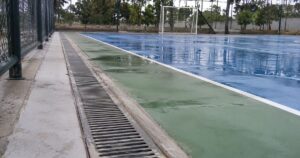
In Kansas City, the hardest thing on a court is not the games, it is the weather. The metro swings through hot, humid summers and winters that repeatedly cross the freezing mark. That freeze-thaw cycling drives water in and out of any crack, and over time it lifts and splits slabs that were not built for it. A properly engineered concrete base with correct thickness, reinforcement, and drainage is what keeps a 30×30 court flat and playable for years.
We generally recommend a reinforced concrete slab with a slight pitch to shed water, plus a plan for where that water goes once it leaves the court. Poor drainage is one of the most common reasons residential courts fail early. You can read more about why drainage is a make-or-break step, and about the standards that drive long-term court surface durability in Kansas City. For specific slab questions, local building codes and a licensed structural professional should guide the final spec.
Choosing Your Surface and Colors
Once the size and base are settled, the surface finish shapes how the court plays and looks. Acrylic hard-court coatings are the most common choice for outdoor residential courts in the Kansas City climate because they hold color, resist UV fade through our long summers, and can be customized with lines and logos. Modular snap-together tiles are another option that drains well and is forgiving on joints.
A 30×30 pad is a great canvas for a custom look. You can match your home’s palette, add a team-inspired color scheme, or lay out a clean two-tone key. Explore combinations with our court color designer to see how different schemes read on a court your size before committing.
Is 30×30 the Right Call for You?
If your main goal is shooting practice, skill development, and casual games for the family, a 30×30 basketball court is big enough and a smart, space-efficient choice for a Kansas City home. If you have the room and want deeper three-point spacing or more competitive half-court play, stretching to 30×40 or beyond is worth considering. The right answer comes down to your lot, your budget, and how you plan to use the space. When you are ready to size yours accurately, reach out through our contact page for a site-specific assessment.